
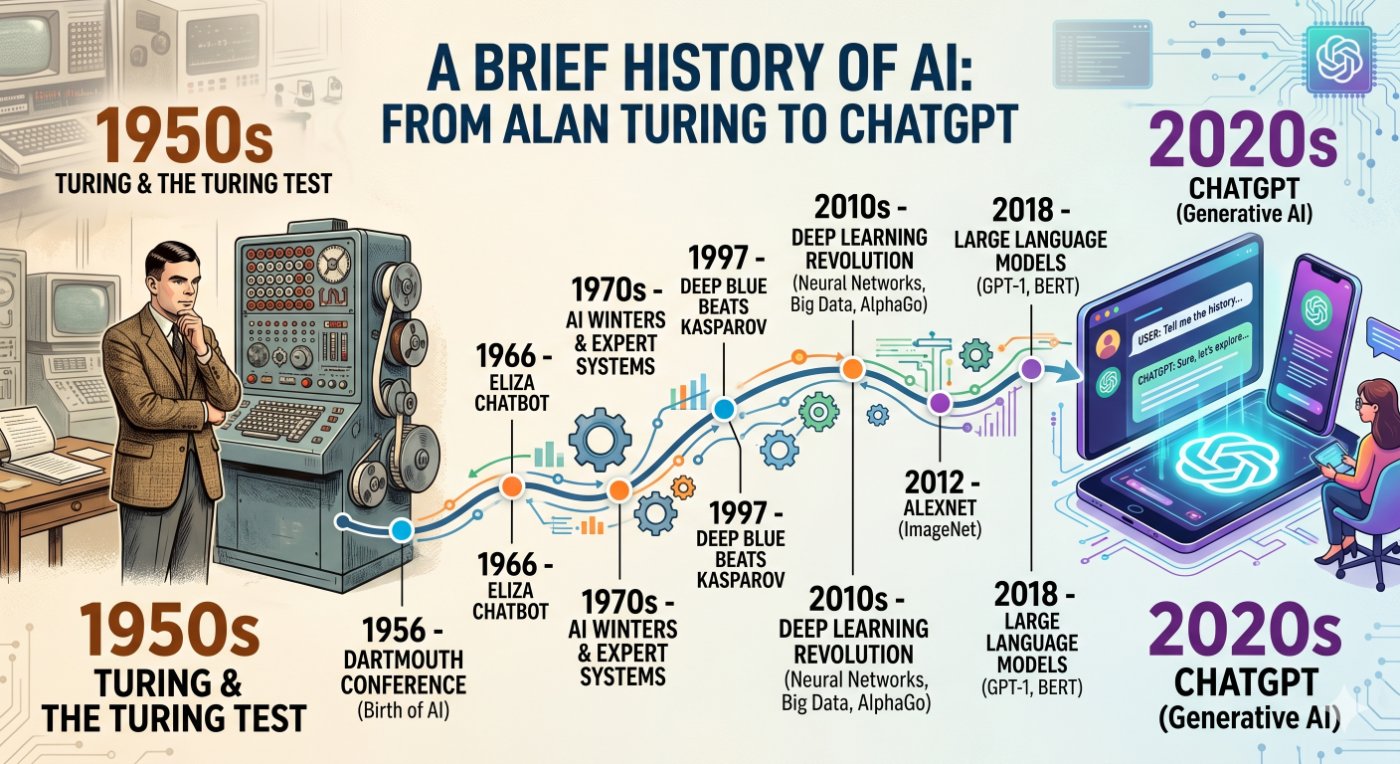
A Brief History of AI: From Alan Turing to ChatGPT
To understand where AI is going, it helps enormously to understand where it has been. The story of artificial intelligence is not a straight line of progress it is a series of grand ambitions, crushing disappointments, and sudden breakthroughs. It is one of the most dramatic stories in the history of science.
1950s: The Dream Begins
In 1950, British mathematician Alan Turing published a paper asking a deceptively simple question: "Can machines think?" He proposed what we now call the Turing Test a conversation test in which a machine that cannot be distinguished from a human would be considered intelligent. This paper launched the field. In 1956, computer scientists John McCarthy, Marvin Minsky, Claude Shannon, and Nathaniel Rochester organized the Dartmouth Conference the event widely credited as the birth of AI as a formal discipline. They were optimistic: many believed human-level AI was just 20 years away.
1960s–70s: The First AI Winter
Early AI programs were impressive within narrow domains they could play checkers, solve algebra problems, and prove mathematical theorems. But they failed completely when the problems grew more complex or ambiguous. Computing power was insufficient, training data was scarce, and the field was plagued by what Minsky later admitted was reckless overconfidence. Funding dried up. AI entered its first "winter" a period of stagnation and disillusionment.
1980s: Expert Systems and the Second Winter
The 1980s brought a revival through "expert systems" programs encoding the knowledge of human specialists in rule-based logic. Companies invested billions. Japan launched its Fifth Generation Computer Project. But expert systems were expensive, brittle, and impossible to scale. By the late 1980s, a second AI winter had arrived.
1990s–2000s: The Quiet Revolution
While AI winters dampened excitement, important progress happened quietly. In 1997, IBM's Deep Blue defeated world chess champion Garry Kasparov. In 2002, the Roomba became the first commercially successful autonomous robot. The internet was generating vast data. GPUs were becoming powerful. The pieces were assembling for something big.
2012: The Deep Learning Explosion
The pivotal moment came in 2012 when a deep neural network called AlexNet, built by Geoffrey Hinton's team, crushed competitors in the ImageNet visual recognition challenge reducing error rates by nearly half. This demonstrated conclusively that deep learning, given enough data and compute, was transformative. The race was on.
- 2016
- DeepMind's AlphaGo defeats world Go champion Lee Sedol a game considered too complex for AI. The world pays attention.
- 2017
- Google researchers publish "Attention Is All You Need" introducing the Transformer architecture that makes modern LLMs possible.
- 2020
- Open AI releases GPT-3, demonstrating that large language models can write, reason, and generalize across tasks.
- 2022
- Chat GPT launches and reaches 100 million users in two months the fastest product adoption in history.
- 2024–26
- Agentic AI enters production. AI agents autonomously browse the web, write code, manage files, and complete multi-step tasks without human prompting at each step.