
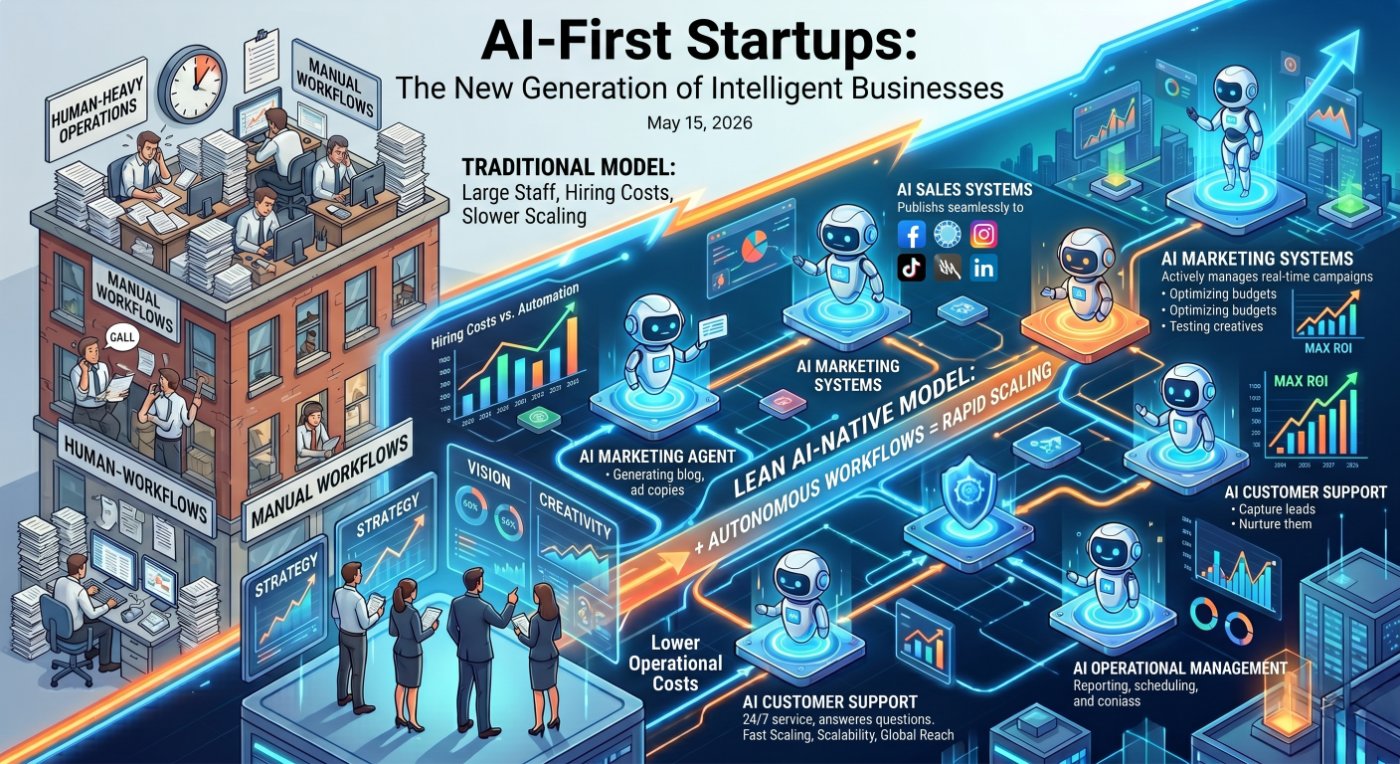
AI-First Startups: The New Generation of Intelligent Businesses
A new wave of startups is rapidly transforming the business world.
Unlike traditional companies that simply “use” Artificial Intelligence as a tool, these businesses are being built around AI from the very beginning.
They are called:
AI-First Startups
These companies place Artificial Intelligence at the center of their operations, products, marketing, customer experience, and decision-making systems.
Instead of adding AI later, AI becomes the foundation of the business itself.
This approach is creating faster, leaner, and more scalable companies than ever before.
What Is an AI-First Startup?
An AI-first startup is a business designed primarily around AI systems and intelligent automation.
In traditional startups:
- Humans perform most operations
- AI is optional support technology
In AI-first startups:
- AI handles significant execution
- Humans focus on strategy, innovation, and growth
AI becomes an operational engine rather than just a software feature.
Traditional Startup vs AI-First Startup
Traditional Startup AI-First Startup Human-heavy operations AI-driven operations Manual workflows Autonomous workflows Larger staffing needs Lean teams Slower scaling Rapid scalability Higher operational costs Lower operational overhead Limited productivity AI-enhanced productivity
Why AI-First Startups Are Growing So Fast
Several major technological advancements have made this possible:
1. Large Language Models (LLMs)
Modern AI can now:
- Understand language
- Generate content
- Analyze data
- Hold conversations
- Assist in decision-making
This enables startups to automate communication and operational tasks.
2. AI Agents
AI agents can:
- Execute workflows
- Manage operations
- Interact with tools
- Automate repetitive work
- Operate autonomously
These systems function almost like digital employees.
3. Workflow Automation
AI systems can integrate with:
- CRM software
- Email platforms
- Payment systems
- Marketing tools
- Analytics dashboards
This allows startups to automate end-to-end business processes.
How AI-First Startups Operate
AI Marketing Systems
AI generates:
- Social media content
- Blog articles
- Advertising campaigns
- Email marketing
while continuously optimizing performance.
AI Sales Systems
AI sales agents can:
- Generate leads
- Send outreach
- Handle follow-ups
- Qualify prospects
- Book meetings automatically
AI Customer Support
AI support systems provide:
- Instant replies
- 24/7 customer service
- Automated onboarding
- Ticket handling
AI Operational Management
AI automates:
- Scheduling
- Reporting
- Data processing
- Administrative workflows
This reduces operational complexity significantly.
Small Teams, Massive Impact
One of the biggest advantages of AI-first startups is leverage.
A small team can now:
- Operate globally
- Serve thousands of customers
- Run complex marketing systems
- Scale sales operations
without building large departments.
This changes the economics of startups completely.
Why Investors Are Interested in AI-First Startups
AI-first businesses offer several attractive advantages:
Lower Operational Costs
Automation reduces staffing and infrastructure expenses.
Faster Growth Potential
AI systems allow startups to scale rapidly.
Higher Efficiency
AI handles repetitive operational tasks continuously.
Data-Driven Optimization
AI systems constantly analyze and improve performance.
Competitive Advantage
AI-native workflows create operational speed that traditional companies struggle to match.
Industries Being Disrupted by AI-First Startups
AI-first startups are rapidly entering industries such as:
- Marketing
- Sales
- Education
- Healthcare
- E-commerce
- Finance
- Customer support
- SaaS platforms
- Consulting
Nearly every industry with repetitive workflows is being affected.
Human Roles in AI-First Startups
AI does not eliminate humans — it changes their role.
Humans increasingly focus on:
- Vision
- Leadership
- Creativity
- Innovation
- Strategic thinking
- Relationship management
AI handles much of the operational execution.
Challenges AI-First Startups Must Solve
Despite the opportunities, these startups also face challenges:
AI Reliability
AI systems still require monitoring and improvement.
Ethical & Legal Concerns
Responsible AI usage is essential.
Data Security
Protecting user data remains critical.
Rapid Technological Change
AI evolves quickly, requiring continuous adaptation.
The Future of AI-First Startups
Many experts believe AI-first startups may become one of the dominant business models of the future.
We are entering a world where:
- Lean teams outperform large organizations
- AI systems manage operational execution
- Autonomous workflows replace manual processes
- Businesses scale faster with fewer resources
The startup landscape is being rewritten in real time.