AI Marketing Systems: How Agentic AI Is Revolutionizing Digital Marketing
Marketing is changing faster in the last few years than it has in the last two decades. The reason is simple:
👉 AI is no longer just creating content — it is now running marketing systems.
These new systems are called AI Marketing Systems, and they are powered by Agentic AI, where intelligent agents don’t just assist marketers — they actively execute marketing tasks.
What Is an AI Marketing System?
An AI marketing system is a fully or partially automated setup where AI agents handle marketing activities such as:
- Content creation
- Social media posting
- Ad campaign management
- Audience targeting
- Lead generation
- Email marketing
- Analytics and optimization
Instead of doing each task manually, businesses define goals — and AI agents execute the entire workflow.
Traditional Marketing vs AI Marketing Systems
Traditional MarketingAI Marketing SystemsManual content creationAI-generated content at scaleHuman-managed campaignsAI-optimized campaignsSlow testing cyclesReal-time optimizationSeparate tools for each taskIntegrated AI workflowsHigh manpower requiredMinimal human supervision
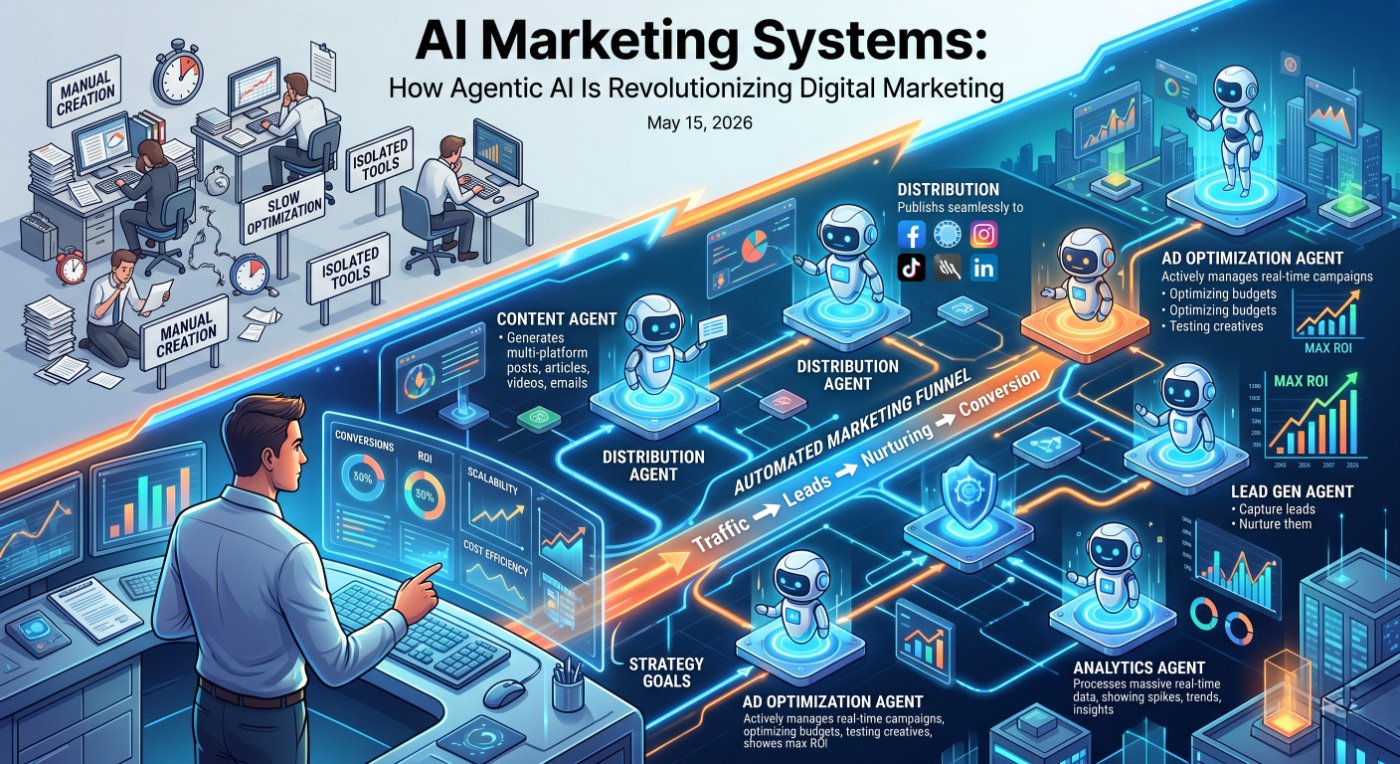
How AI Marketing Systems Work
Modern AI marketing systems operate like a digital marketing department made of intelligent agents.
1. Strategy Agent
Defines marketing goals:
- Brand awareness
- Lead generation
- Sales conversion
2. Content Agent
Creates:
- Social media posts
- Blog articles
- Ad copies
- Video scripts
3. Distribution Agent
Publishes content across:
- TikTok
- Email platforms
4. Ad Optimization Agent
Manages paid ads by:
- Testing creatives
- Adjusting targeting
- Optimizing budget
- Improving ROI
5. Analytics Agent
Tracks performance:
- Click-through rates
- Engagement
- Conversions
- Customer behavior
Then it suggests improvements automatically.
Why Businesses Are Adopting AI Marketing Systems
1. Speed
Marketing campaigns that used to take days can now be executed in minutes.
2. Cost Efficiency
Businesses reduce dependence on large marketing teams and agencies.
3. Scalability
One system can manage multiple brands, campaigns, and platforms simultaneously.
4. Data-Driven Decisions
AI continuously analyzes performance and improves results in real time.
5. 24/7 Operation
AI systems never stop optimizing and publishing content.
Real-World Use Cases
E-commerce Brands
- Product ads
- Retargeting campaigns
- Automated product descriptions
- Email promotions
Coaching & Education Businesses
- Lead funnels
- Webinar promotion
- Email nurturing sequences
- Social media growth
Agencies
- Client campaign automation
- Content production at scale
- Performance reporting
- Ad optimization
AI Marketing vs Human Marketing Teams
AI marketing systems are not just faster — they fundamentally change how marketing teams operate.
Human TeamAI Marketing SystemLimited outputInfinite content generationRequires coordinationSelf-orchestrating agentsTime-based executionInstant executionHigh cost scalingLow cost scaling
The Rise of Fully Automated Marketing Funnels
One of the most powerful applications of AI marketing systems is the fully automated funnel:
- AI generates content
- Content drives traffic
- Leads enter system
- AI nurtures leads via email/DM
- AI qualifies prospects
- AI books sales calls
- Human closes high-value deals
This creates a semi-autonomous revenue system.
Challenges of AI Marketing Systems
Despite the advantages, there are challenges:
- Brand voice consistency
- Over-automation risks
- Quality control issues
- Platform policy compliance
- Need for human strategy oversight
The best systems use a hybrid model:
👉 AI executes
👉 Humans strategize
Future of AI Marketing Systems
In the near future, marketing departments may look like this:
- 1 marketing strategist
- Multiple AI agents handling execution
- Fully automated content pipelines
- Real-time optimization systems
Marketing will shift from manual execution to system orchestration.