
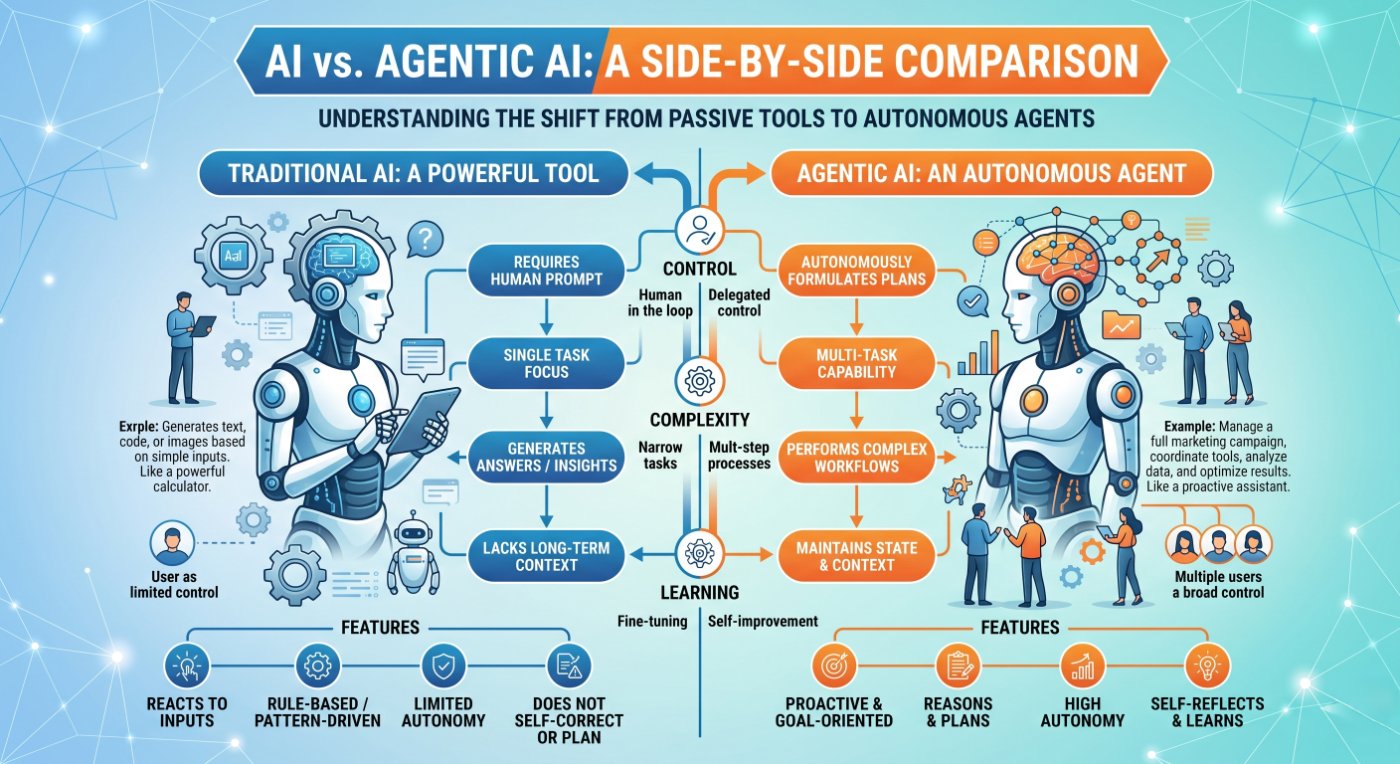
AI vs. Agentic AI: A Side-by-Side Comparison
The difference between traditional AI and agentic AI is not just technical it is philosophical. It changes what you can delegate, how much you need to be involved, and what risks you are taking on. This blog lays out the comparison clearly so you can make informed decisions about which type of AI fits which situation.
DIMENSION TRADATIONAL AI AGENTIC AI
- Input A single prompt or query A high-level goal or mission
- Output A single response (text, image, code) A completed multi-step task or workflow
- Memory Limited to the current conversation Persistent across steps and sessions
- Tool Use Minimal or none Web, code, APIs, files, email, databases
- Autonomy Zero waits for human each step High self-directs until goal is met
- Error Handling Reports errors; cannot self-correct Detects and adapts to failures autonomously
- Human Involvement Required at every step Required only at start and key checkpoints
- Best For Q&A, Drafting, summarizing, classifying Research, automation, complex workflows
- Risk Level Low each action is reviewed by human Higher actions happen before review
- Example" Summarize this article"" Monitor my competitors and alert me weekly"
When to Use Traditional AI
Traditional AI remains the right choice for well-defined, single-step tasks where you want full control and review of every output: drafting an email, summarizing a meeting, translating a document, generating an image, answering a factual question. These tasks are clear, bounded, and low-risk. You review the output before anything happens with it.
When to Use Agentic AI
Agentic AI becomes compelling for tasks that are complex, multi-step, time-consuming, or repetitive especially those where the path from goal to result requires many decisions along the way. Research projects, software development pipelines, customer service workflows, data gathering and reporting these are where agents add transformative value.
Higher autonomy means higher risk. Agentic AI can take actions in the real world sending emails, spending money, modifying files. Always scope permissions carefully and implement human review checkpoints for high-stakes actions.