
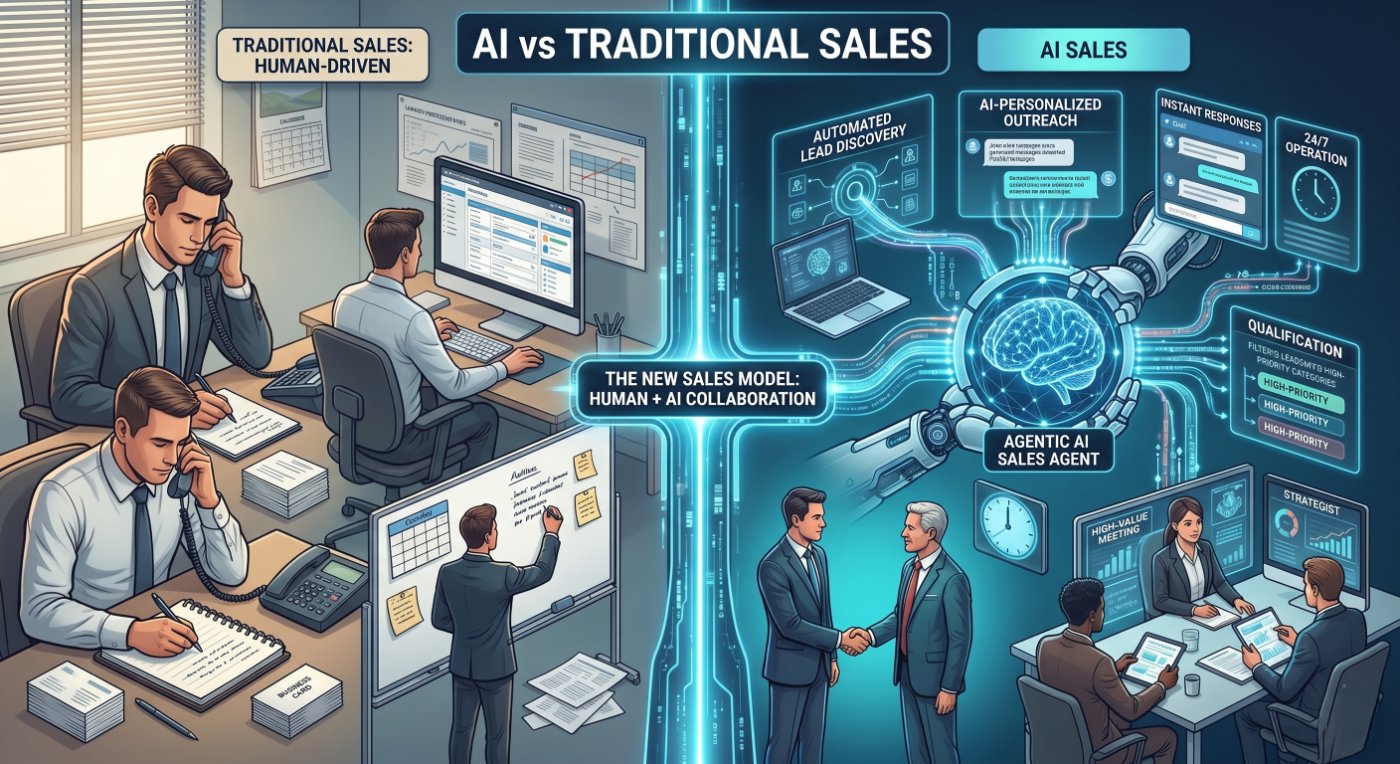
AI vs Traditional Sales: Why Human Sales Teams Are Changing Forever
Sales has always been the heart of every business. No matter how good a product or service is, without effective sales, a company cannot grow.
For decades, sales has depended on human effort sales representatives making calls, sending emails, following up with leads, and closing deals.
But now a major shift is happening:
AI is entering the sales department
And it is not just assisting sales teams it is beginning to replace and restructure how sales works entirely.
This is the rise of AI-powered sales systems and Agentic AI sales agents.
Traditional Sales Teams: How They Work
In a traditional setup, sales teams depend on human effort for every step:
- Finding leads manually
- Contacting prospects one by one
- Writing personalized messages
- Following up repeatedly
- Tracking everything in CRM systems
- Scheduling meetings manually
- Closing deals through human persuasion
This model works but it has limitations:
- Time-consuming
- Expensive
- Inconsistent
- Limited scalability
- Dependent on human performance
What AI Sales Systems Are Changing
AI is transforming sales from a human-driven process into a system-driven process.
AI sales agents can now:
- Find and analyze leads automatically
- Write personalized outreach messages
- Send emails and follow-ups at scale
- Respond to customer replies
- Qualify prospects
- Book meetings automatically
- Update CRM systems in real time
Instead of humans doing every step, AI handles execution while humans focus on strategy.
AI Sales vs Traditional Sales: Key Differences
Traditional Sales AI Sales Systems Manual lead generation Automated lead discovery Human written messages AI-personalized outreach Limited daily output Thousands of interactions daily Working hours limited24/7 operation Slow follow-up instant responses High cost per sales person Low marginal cost per lead Human inconsistency System-driven consistency
How AI Sales Agents Actually Work
Modern AI sales systems operate like digital sales teams.
Step 1: Lead Generation
AI scans data sources to identify potential customers based on:
- Industry
- Location
- Behavior
- Interest signals
Step 2: Lead Research
AI analyzes each prospect:
- Company size
- Pain points
- Decision makers
- Online activity
Step 3: Personalized Outreach
AI generates customized messages for each lead:
- Emails
- LinkedIn messages
- SMS or WhatsApp messages
Each message is tailored, not generic.
Step 4: Automated Follow-ups
AI ensures no lead is lost:
- Sends reminders
- Adjusts tone based on responses
- Keeps engagement alive
Step 5: Qualification
AI filters leads based on:
- Interest level
- Budget
- Buying intent
Only high-quality leads reach human sales teams.
Step 6: Meeting Booking
AI schedules calls directly into calendars without human involvement.
Why Businesses Are Switching to AI Sales Systems
1. Speed
AI responds instantly no delays, no waiting.
2. Scale
One AI system can handle thousands of leads at once.
3. Cost Efficiency
Businesses reduce the need for large sales teams.
4. Consistency
AI follows structured sales processes every time without variation.
5. 24/7 Sales Operations
AI never sleeps, meaning sales never stop.
The New Sales Model: Human + AI Collaboration
Even with AI advancement, humans are not completely removed from sales.
Instead, the model is changing:
- AI handles outreach and follow-ups
- AI filters and qualifies leads
- AI manages CRM updates
- Humans focus on closing high-value deals
- Humans handle relationships and negotiation
This creates a hybrid sales system that is more efficient and scalable.
Real Impact on Sales Teams
Companies adopting AI sales systems are seeing:
- Faster lead response times
- Increased number of qualified leads
- Lower operational costs
- Higher conversion efficiency
- Better pipeline management
In many cases, one AI system can do the work of multiple sales representatives.
Challenges of AI Sales Systems
Despite the benefits, there are challenges:
1. Personalization Quality
AI must be trained to maintain authentic messaging.
2. Trust Building
Some high-value deals still require human interaction.
3. Data Accuracy
AI performance depends on the quality of input data.
4. Ethical Use
Businesses must ensure compliance with messaging and privacy regulations.
The Future of Sales
Sales is no longer just a human-driven profession.
It is becoming a system-driven function powered by AI agents.
In the future, sales teams may look like:
- 1 sales strategist
- Multiple AI sales agents
- Human closers for high-value deals
Instead of large teams, companies will rely on intelligent sales systems.