
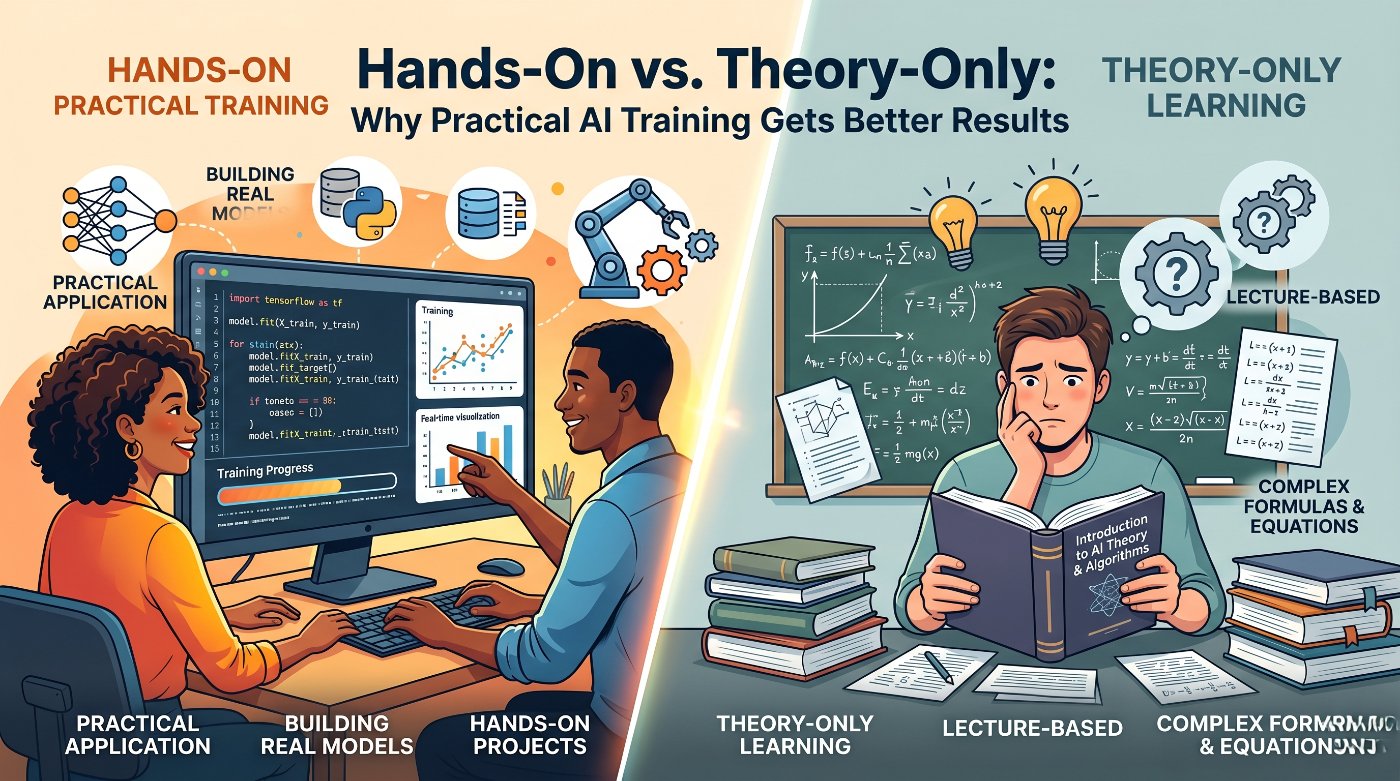
Hands-On vs. Theory-Only: Why Practical AI Training Gets Better Results
There are two ways people try to learn AI. The first is reading and watching: books, articles, videos, lectures. The second is doing: building things, running experiments, breaking things, fixing them. Research in educational psychology is unambiguous about which approach produces durable, applicable skills and the field of AI is no exception.
Why Theory Alone Falls Short
Understanding AI conceptually is valuable but it does not translate automatically into the ability to use AI effectively. Many people who have read extensively about AI still write mediocre prompts, choose the wrong tools for their tasks, and fail to integrate AI into their workflows. Theory gives you a map; practical experience gives you the ability to actually navigate the terrain.
AI tools are also deeply contextual. The optimal way to use Claude for legal document review is different from how you use it for creative writing, which is different again from how you use it for data analysis. These nuances only reveal themselves through use.
The Case for Project-Based Learning
The most effective AI training programs are built around real projects: use AI to improve your actual work product; build an agent that automates a task you genuinely find tedious; analyze a dataset from your industry; build a chatbot that answers questions from a document you use at work. When the project is real, the feedback is real and real feedback accelerates learning faster than any amount of passive study.
The Role of Guided Failure
Practical training also means failing and failing in a guided environment where someone can help you understand why something did not work. Prompt engineering, for instance, is largely learned through iteration: you write a prompt, get a suboptimal result, adjust, and try again. This trial-and-error loop, when guided by someone who understands the principles, compresses learning dramatically.:
Our recommendation: Allocate at least 60% of your AI learning time to hands-on practice. For every concept you learn, immediately find a way to apply it. The learners who progress fastest are not those who study the hardest they are those who build the most.