How AI Agents Are Transforming Healthcare & What It Means for Patients
Healthcare is one of the most data-rich, time-intensive, and consequential industries in the world which makes it one of the most promising domains for AI transformation. The potential is enormous: AI that helps doctors diagnose faster and more accurately, agents that monitor patients continuously, systems that accelerate drug discovery from decades to years. But the stakes are also uniquely high: errors in healthcare can cost lives.
AI in Diagnosis
AI systems are achieving diagnostic accuracy in certain narrow domains that rivals or exceeds human specialists. Google's DeepMind developed an AI that detected over 50 eye diseases from retinal scans with accuracy matching world-leading ophthalmologists. AI systems for radiology can flag potential tumors in CT scans faster and with fewer false negatives than exhausted radiologists working long shifts. These tools are not replacing doctors they are giving doctors a second opinion that never tires.
Agentic AI in Patient Monitoring
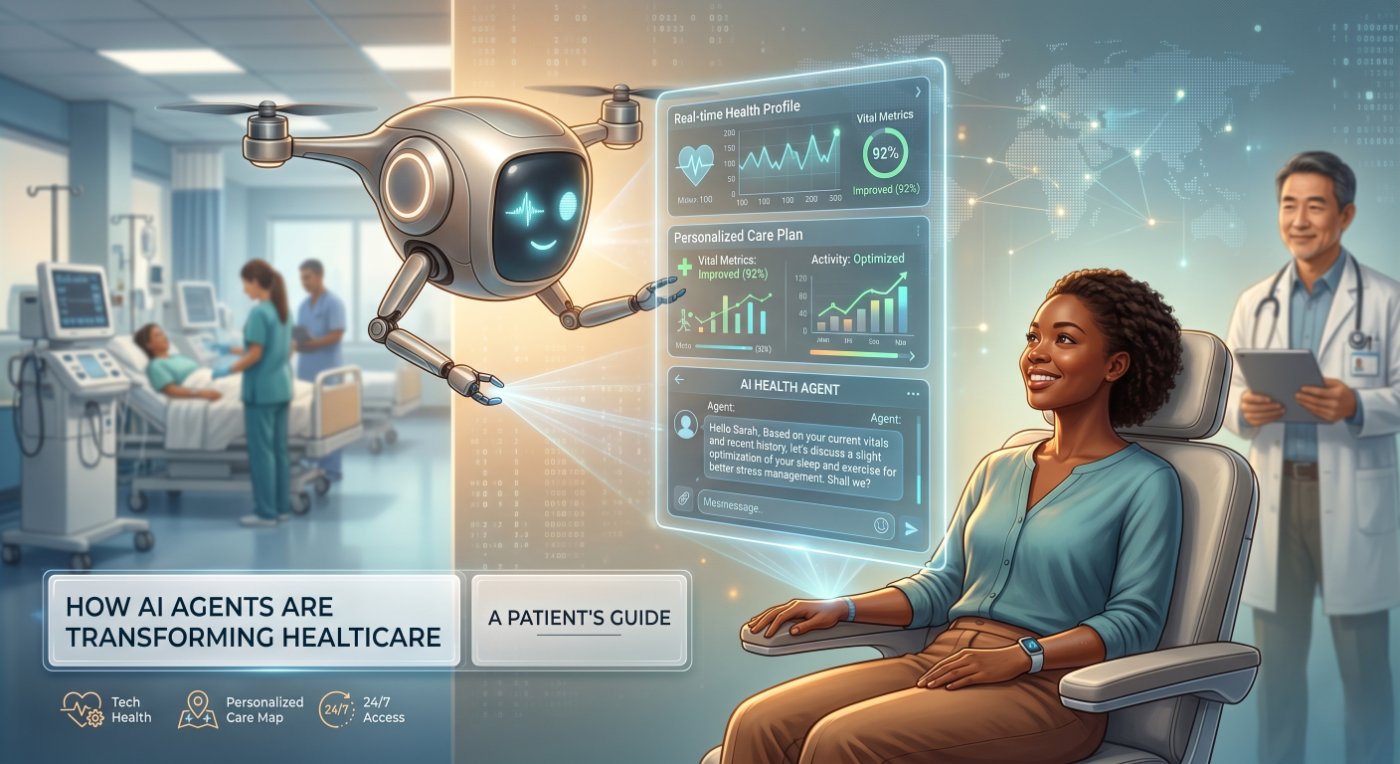
Agentic AI is transforming patient monitoring. Continuous monitoring agents analyze streams of data from wearables, hospital sensors, and electronic health records flagging deterioration before it becomes a crisis. An agent monitoring a post-surgical patient can detect early signs of sepsis changes in heart rate variability, temperature trends, lab values and alert the care team hours before the patient would show obvious symptoms. This shift from reactive to proactive care saves lives.
Drug Discovery
Traditional drug discovery takes an average of 12 years from molecule to market. AI is compressing this dramatically. DeepMind's Alpha Fold solved the protein folding problem determining the 3D structure of proteins from their amino acid sequences a challenge that had stumped scientists for 50 years. This breakthrough enables AI-powered drug discovery at unprecedented speed. Agentic AI systems are now being used to hypothesize candidate molecules, predict their interactions, design experiments, and interpret results closing the loop between hypothesis and insight far faster than human research teams alone.
Critical Caveat: Healthcare AI must be held to the highest standards of validation, transparency, and bias testing. An AI diagnostic tool trained primarily on data from one demographic group may perform poorly on others. Every AI healthcare application requires rigorous clinical validation before deployment AI is a powerful assistant, not a replacement for clinical judgment.