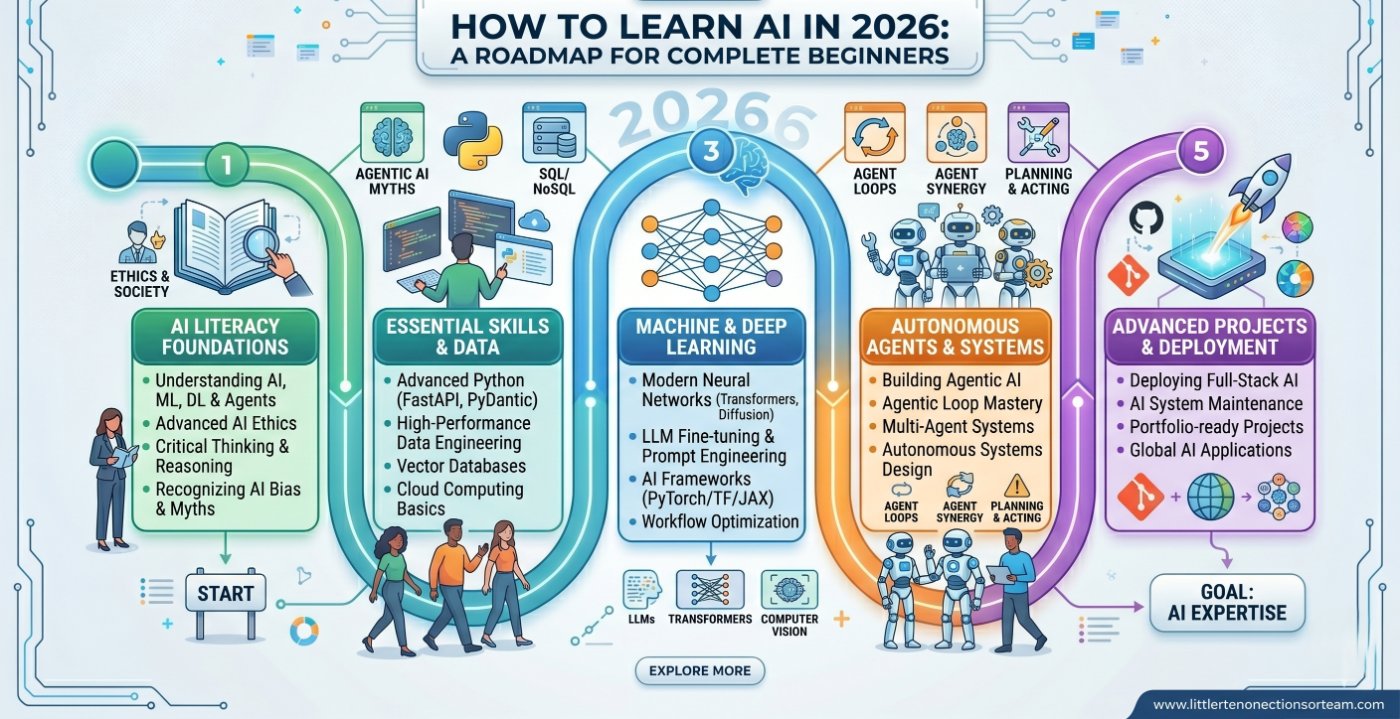
How to Learn AI in 2026: A Roadmap for Complete Beginners
The amount of content about AI is overwhelming. Tutorials, courses, YouTube videos, research papers, podcasts it is genuinely hard to know where to start or what to prioritize. This blog gives you a structured, honest roadmap: what to learn, in what order, and why for someone starting from zero.
Phase 1: Build Your Conceptual Foundation (Weeks 1–2)
Before touching any tools, develop a solid mental model of what AI is. Read accessible books like "Human Compatible" by Stuart Russell or "The Alignment Problem" by Brian Christian. Watch foundational explainer videos. Your goal is to understand the key concepts machine learning, neural networks, training data, LLMs, agents at a level where you can explain them to someone else. This foundation makes everything that follows stick better.
Phase 2: Become a Power User of AI Tools (Weeks 3–6)
Get hands on with the major AI tools: Chat GPT, Claude, Gemini, Perplexity. Use them daily for real tasks not just experiments. Write emails, summarize documents, brainstorm ideas, analyze data, generate code even if you are not a developer. The goal is to develop intuition for what these tools are good at, where they fail, and how to prompt them effectively. This phase accelerates with daily use treat it like learning a new language by living in the country.
Phase 3: Learn Prompt Engineering (Weeks 5–8)
Prompt engineering the art of writing instructions that reliably get excellent AI outputs is arguably the highest-leverage skill in AI right now. Learn the core techniques: role prompting, chain-of-thought prompting, few-shot examples, structured output requests. Practice deliberately. The difference between a mediocre prompt and an excellent one is not the AI model it is the human writing the instructions.
Phase 4: Explore Agentic AI and Automation (Weeks 8–12)
Once you are comfortable with AI tools, begin exploring automation. Zapier and Make (formerly Integromat) allow you to build AI-powered workflows without code. Then explore tools like Relevance AI or n8n for more sophisticated agent building. Your goal is to build something that runs autonomously and delivers real value even something simple like an agent that monitors a website and summarizes changes daily.
Phase 5: Specialize in Your Domain (Ongoing)
AI looks different in every field. A doctor using AI is focused on clinical decision support and privacy. A marketer is focused on content generation and analytics. A lawyer cares about document review and legal research tools. Once you have the foundations, specialize: find the specific AI tools and applications most relevant to your profession and go deep. This is where you become genuinely invaluable.
The most important rule: Use AI daily. The gap between someone who reads about AI and someone who uses it daily is vast. Theory without practice stalls. Start using tools in week one even as you are learning the concepts.