
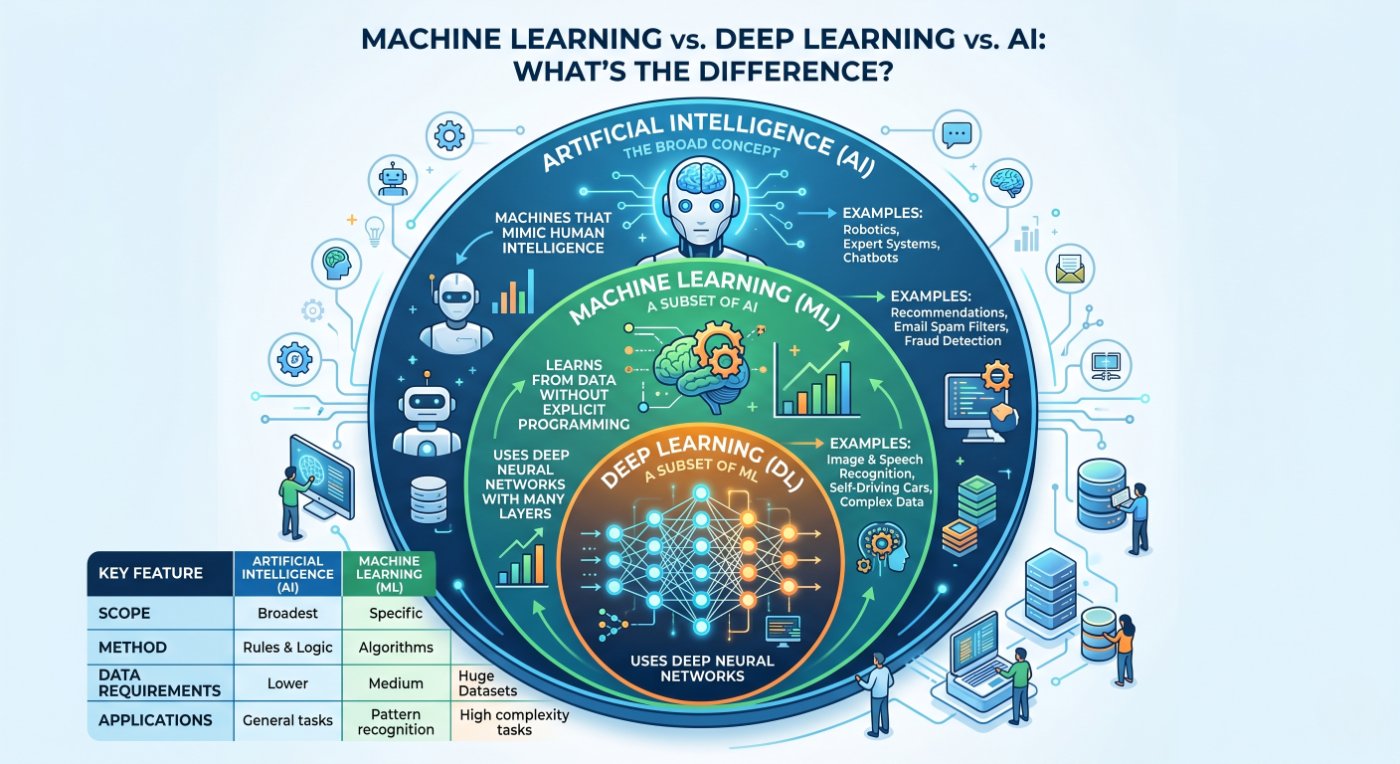
Machine Learning vs. Deep Learning vs. AI: What's the Difference?
Three terms dominate every AI conversation: Artificial Intelligence, Machine Learning, and Deep Learning. They are often used interchangeably sometimes by people who should know better. In reality, they describe three nested concepts, each more specific than the last. Getting them straight is the first step to genuinely understanding the field.
The Russian Dolls of AI
Think of these three concepts as Russian nesting dolls.
Artificial Intelligence: The Big Umbrella
AI encompasses any technique that enables a machine to mimic human intelligence. This includes rule-based systems (if-then logic programmed by humans), search algorithms (like those that power Google Maps), and learning systems (that improve with data). Early AI was mostly rule-based programmers wrote thousands of explicit instructions. These systems were brittle: they only worked within their programmed rules.
Machine Learning: Teaching by Example
Machine Learning was a paradigm shift. Instead of writing rules, engineers feed the system enormous amounts of data and let it discover the rules itself. A spam filter trained with ML is not given a list of spam phrases it is shown millions of spam emails and millions of legitimate emails, and it figures out the patterns on its own. This makes ML systems far more flexible and generalizable than hand-coded rule systems.
Common ML techniques include decision trees, random forests, support vector machines, and linear regression. These work well for structured data spreadsheets of numbers and categories.
Deep Learning: The Neural Network Revolution
Deep Learning is ML using artificial neural networks systems loosely inspired by the structure of the human brain, with layers of interconnected nodes (neurons) that process information. "Deep" refers to the many layers in these networks. Each layer learns increasingly abstract representations of the data: early layers detect edges in an image; deeper layers detect shapes; the deepest layers detect faces.
Deep learning is why AI made such dramatic leaps after 2012. It powers image recognition, speech-to-text, language translation, and most importantly today large language models like GPT-4, Claude, and Gemini.
When someone says "our AI system," understanding whether they mean a rule-based system, a traditional ML model, or a deep learning model tells you a great deal about its capabilities, limitations, and trustworthiness.
Where Generative AI Fits
You have probably heard "Generative AI" systems that create text, images, code, and audio. Generative AI is a subset of deep learning. Models like ChatGPT and Mid journey are deep learning systems trained on massive datasets that learned to generate new, original content rather than just classify or predict existing data. Generative AI is the most visible frontier of deep learning today.
"AI is the destination. Machine Learning is the road. Deep Learning is the fastest vehicle on that road. Knowing which one you're dealing with changes everything."