
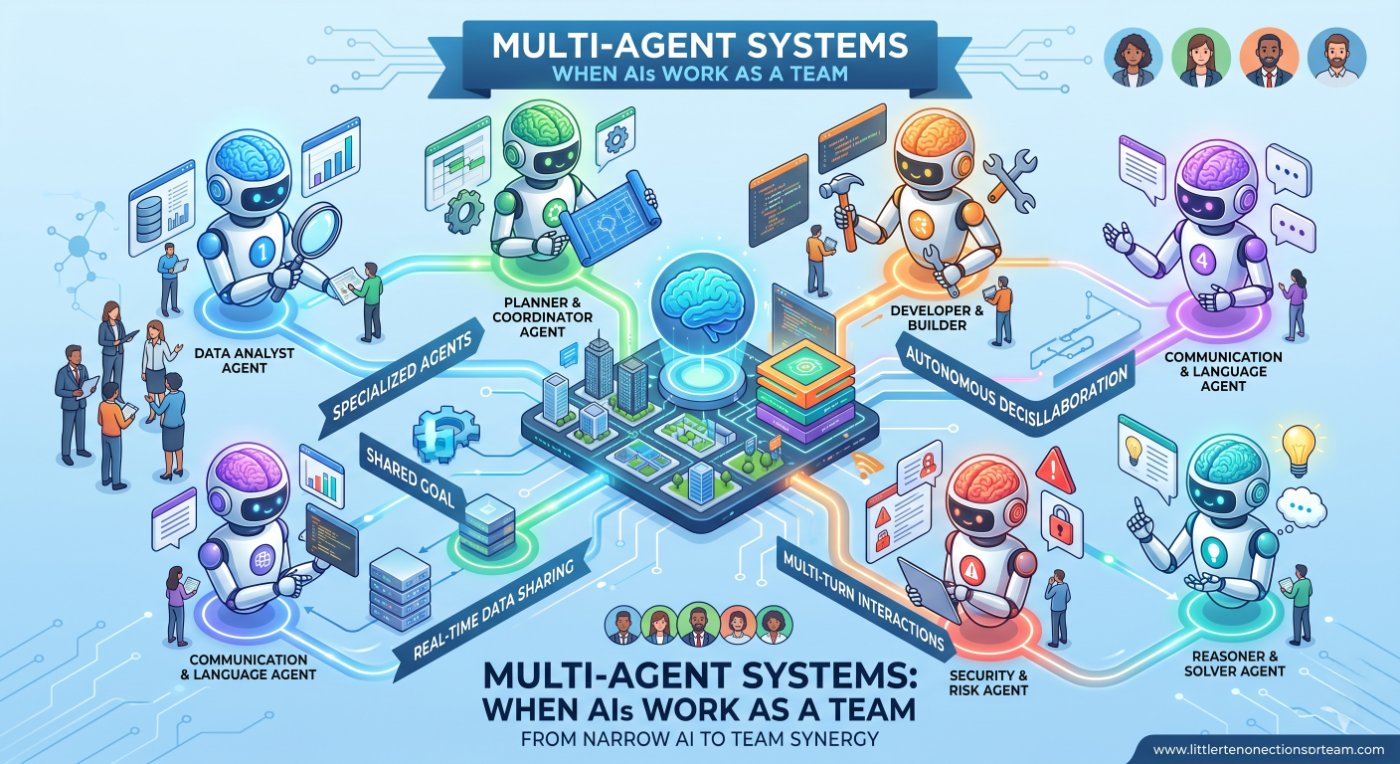
Multi-Agent Systems: When AIs Work as a Team
A single AI agent is impressive. But what happens when you build a team of agents each specialized, each with different tools and knowledge, coordinated by an orchestrating agent? What you get is a multi-agent system: one of the most powerful architectures in modern AI, and the direction in which the entire field is rapidly moving.
Why One Agent Is Not Always Enough
A single agent faces inherent limitations: its context window (how much it can "hold in mind" at once) is finite, it cannot specialize deeply in many domains simultaneously, and long complex tasks can drift as the agent loses track of earlier context. Just as no single human can be a world-class researcher, writer, programmer, and designer simultaneously, a single agent often performs suboptimally across all dimensions of a complex project.
The Multi-Agent Architecture
Multi-agent systems solve this by dividing labor. An receives the high-level goal and breaks it into sub-tasks. It assigns each sub-task to a designed for that specific function. Specialist agents work independently, using their dedicated tools and domain knowledge, then report results back to the orchestrator, which synthesizes them and proceeds to the next phase.: A market research multi-agent system might include a "Research Agent" that searches the web and reads reports, a "Data Agent" that structures findings into spreadsheets, an "Analysis Agent" that identifies trends and insights, and a "Writing Agent" that composes the final report — all coordinated by an orchestrator that manages the workflow from goal to polished deliverable.
Agent Communication and Trust
Agents in a multi-agent system communicate through structured messages. The orchestrator sends instructions; specialists send results. A critical design challenge is trust: should a specialist blindly follow every orchestrator instruction, or should it apply its own safety checks? The emerging consensus is that every agent in a system must maintain its own ethical guidelines and safety constraints — it cannot simply defer to another agent that claims authority.
Real-World Applications
Multi-agent systems are already deployed in software development (coding agent + testing agent + documentation agent), in content production (research + writing + editing + SEO agents), in customer service (triage agent + specialist agents for different product lines), and in scientific research (literature review + hypothesis generation + experimental design agents). The productivity multiplier over single-agent systems let alone human teams is substantial.
"Multi-agent systems are the organizational breakthrough that allows AI to tackle projects of human-organizational complexity with the speed and scale that only machines can provide."