
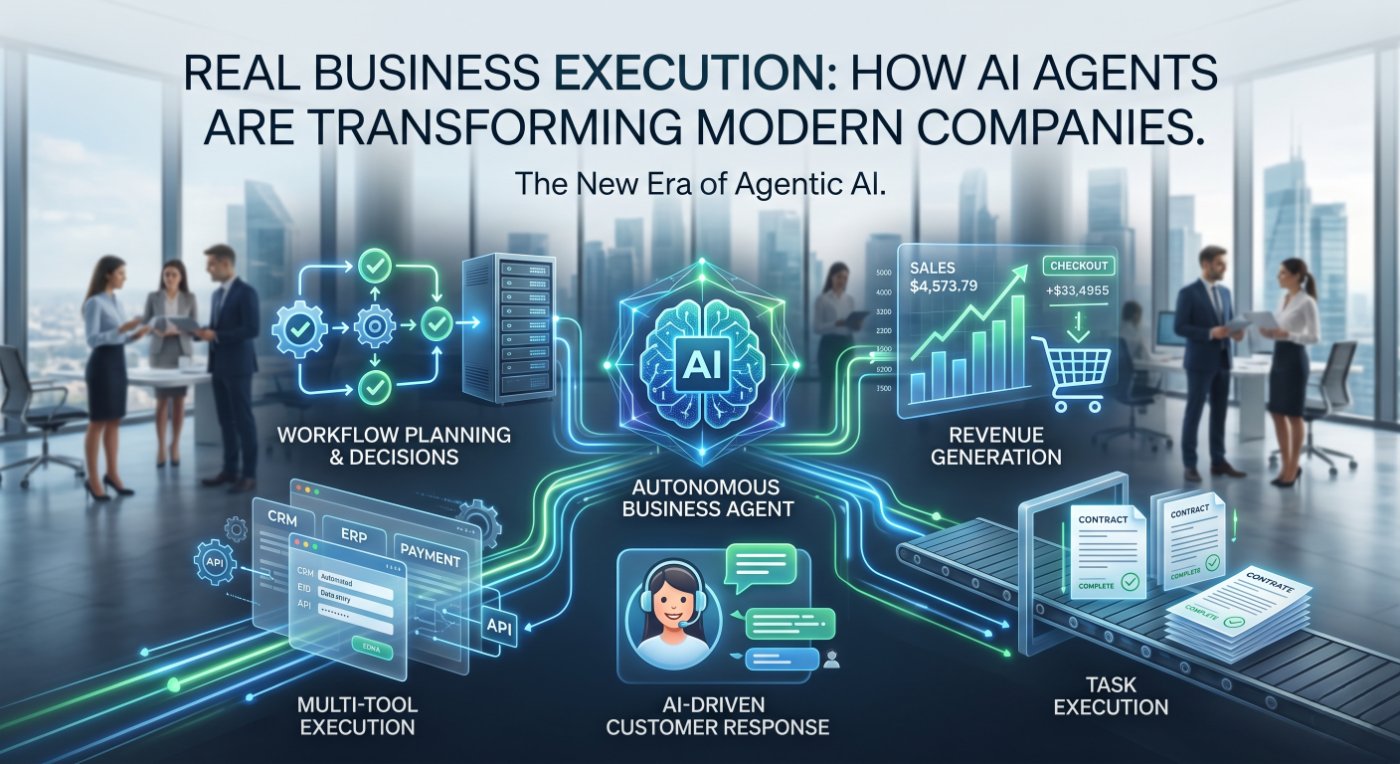
Real Business Execution: How AI Agents Are Transforming Modern Companies
Artificial Intelligence is no longer limited to answering questions or generating content.
Today, AI systems are entering a completely new phase:
Real Business Execution
This means AI can now perform actual business operations autonomously — not just assist humans.
Modern AI agents are capable of:
- Completing tasks
- Managing workflows
- Making decisions
- Using software tools
- Communicating with customers
- Generating revenue-driving activities
This is the foundation of the rapidly growing world of Agentic AI.
What Does “Real Business Execution” Mean?
Traditional AI systems mostly focused on assistance:
- Writing text
- Answering questions
- Creating summaries
- Helping users brainstorm ideas
But AI agents go far beyond assistance.
They can now execute real operational work inside businesses.
Instead of simply helping employees, AI agents can function like digital team members.
Example: Traditional AI vs AI Business Execution
Traditional AI Assistant
A user asks:
“Write a marketing email.”
The AI generates the email.
AI Agent Performing Real Business Execution
The AI system:
- Identifies potential customers
- Researches their interests
- Writes personalized outreach
- Sends campaigns automatically
- Tracks responses
- Books appointments
- Updates CRM systems
- Generates reports
The AI handles the operational workflow itself.
Areas Where AI Is Already Executing Business Tasks
Sales Operations
AI agents can:
- Generate leads
- Qualify prospects
- Send follow-ups
- Manage pipelines
- Analyze customer behavior
Businesses are increasingly deploying autonomous sales systems to improve efficiency and scale outreach operations.
Marketing Execution
AI systems now autonomously:
- Create content
- Run ad campaigns
- Optimize targeting
- Analyze performance metrics
- Schedule publishing
Modern marketing teams are beginning to operate with AI-driven automation layers integrated into daily operations.
Customer Service
AI agents can:
- Handle customer inquiries
- Process support tickets
- Resolve common issues
- Escalate complex situations
- Operate continuously 24/7
Many companies are adopting AI customer support agents to reduce operational load while improving response times.
Administrative Operations
AI workflows can automate:
- Scheduling
- Reporting
- Data processing
- Internal approvals
- Documentation management
Why This Is a Major Shift
For decades, software required humans to operate systems manually.
Now AI can:
- Understand goals
- Plan actions
- Execute workflows
- Adapt dynamically
This changes software from a passive tool into an active operator.
That is why many experts believe AI agents may become one of the most transformative technologies in business history.
The Rise of AI-Native Businesses
A new generation of companies is emerging where AI systems handle large portions of operations.
These businesses use:
- AI sales agents
- AI marketing systems
- AI automation workflows
- AI analytics
- AI customer support
Some startups are already operating with extremely small human teams supported heavily by autonomous AI systems.
Human Roles Will Still Matter
AI agents are powerful, but human leadership remains essential.
Humans will continue focusing on:
- Strategy
- Vision
- Creativity
- Relationships
- Ethical oversight
- Decision approval
The future is likely to be:
Humans + AI Agents working together
rather than complete replacement.
Challenges Businesses Must Consider
As AI execution systems grow more capable, businesses must address:
- Data security
- AI reliability
- Human supervision
- Ethical governance
- Regulatory compliance
Responsible implementation will be critical.
The Future of Business Operations
The shift from AI assistance to AI execution is already underway.
In the coming years, businesses may routinely operate with:
- AI sales teams
- AI marketing departments
- AI operational managers
- AI research agents
- Multi-agent AI systems
Companies that learn how to integrate AI execution early will gain major competitive advantages in speed, scalability, and efficiency.