
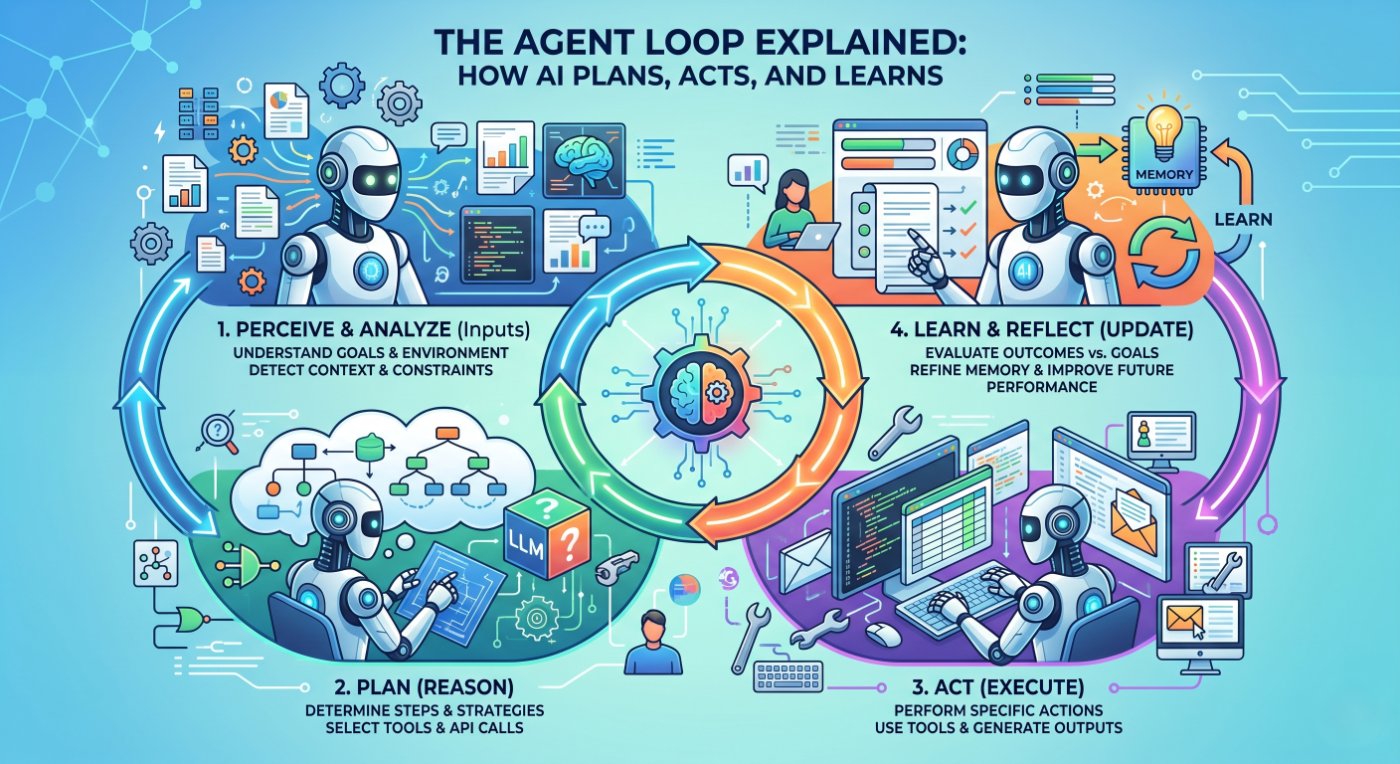
The Agent Loop Explained: How AI Plans, Acts, and Learns
At the heart of every agentic AI system is a simple but powerful cycle. Engineers call it the "agent loop" a repeating process of thinking, acting, and observing that allows an AI to tackle complex, multi-step tasks with minimal human involvement. Understanding this loop demystifies how agents work and helps you anticipate both their strengths and their failure modes.
Step 1: Receive the Goal
Everything begins with an objective. Unlike a chatbot that responds to individual questions, an agent receives a high-level goal "Find me the best deal on flights from Karachi to London in July" or "Debug this Python script and make all tests pass." This goal becomes the agent's mission until it is complete or until the agent determines it cannot be completed.
Step 2: Plan
The agent's reasoning engine (typically an LLM) analyzes the goal and breaks it down into a sequence of sub-tasks. This planning might be explicit the agent writes out a step-by-step plan before doing anything or implicit, deciding on each next step as it goes. More sophisticated agents use techniques like "chain-of-thought" reasoning, thinking through their approach before taking action.
Step 3: Act
The agent executes the next step in its plan using whatever tools are available: searching the web, reading a file, running code, calling an API, writing to a database, or sending a message. Each action is a deliberate choice based on the current state of progress toward the goal.
Step 4: Observe
After acting, the agent examines the result. Did the web search return useful information? Did the code run successfully? Did the API call return the expected data? This observation is fed back into the agent's context updating its understanding of the current situation.
Step 5: Reflect and Repeat
With the observation in hand, the agent decides: Is the goal complete? If yes, it delivers the result. If no, it updates its plan and takes the next action. This loop continues plan, act, observe, adjust until the task is finished, a dead-end is reached, or a human checkpoint is triggered.
The loop breaks down when planning is poor (the agent chooses wrong sub-tasks), when tools return unreliable results, when the agent does not correctly interpret observations, or when it gets stuck in loops without making progress. Good agent design includes safeguards against all of these failure modes.
Memory Across the Loop
What makes the loop powerful is memory. The agent accumulates context as it progresses: every search result, every file it has read, every error it has encountered. This growing context helps it make better decisions at each step. Long-term memory stored in vector databases allows agents to remember past conversations and tasks across sessions, making them progressively more useful over time.
"The agent loop is deceptively simple: think, act, observe, repeat. But within this loop lives the potential to complete tasks that once required entire human teams."