
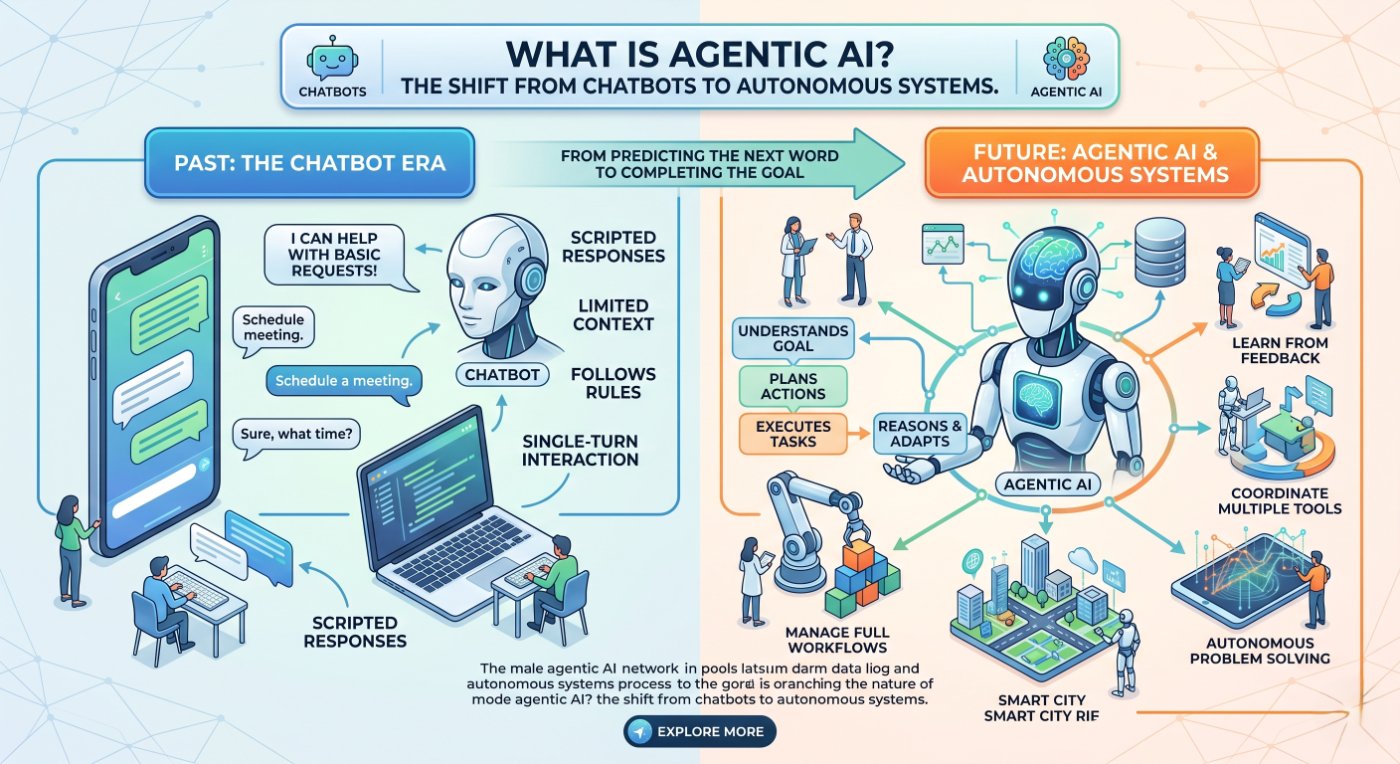
What Is Agentic AI? The Shift from Chatbots to Autonomous Systems
For the past few years, most people's experience with AI has followed a familiar pattern. You open a chat interface, type a question, read the response, type another question. Back and forth. Human leads, AI follows. The AI is reactive it exists to serve each individual request, then waits. This model is powerful, but it has a hard ceiling. Every step still requires a human. Every task still needs a human to initiate, review, and forward the result.
Agentic AI breaks this ceiling. And in doing so, it represents one of the most significant shifts in the history of computing.
What Makes an AI "Agentic"?
An "agent" in AI refers to a system that pursues a goal autonomously perceiving its environment, making decisions, taking actions, observing outcomes, and adjusting its approach all without a human directing each step. The word comes from the philosophical concept of "agency": the capacity to act independently in the world.
Agentic AI, therefore, is an AI system that is given a goal rather than a single prompt, and then figures out on its own what steps to take, what tools to use, what order to do things in, and how to handle obstacles, all the way to completion.
Traditional AI answers a question. Agentic AI completes a mission. Traditional AI responds. Agentic AI acts. Traditional AI is a consultant you call. Agentic AI is a colleague you delegate to.
The Four Pillars of Agentic AI
What transforms a capable language model into an AI agent? Four key components working together:
01: A Reasoning Engine usually a large language model that can plan, strategize, and decide what to do next given a goal and the current state of the world.
02: Memory the ability to retain information across steps (working memory) and across sessions (long-term memory). Without memory, an agent forgets what it has already done and cannot build on its progress.
03: Tools Access to external capabilities: web search, code execution, file management, API calls, email sending, database queries, and more. Tools are what give an agent real-world reach beyond conversation.
04: A Feedback Loop The ability to observe the results of its actions and adjust its plan accordingly. If a web search returns unhelpful results, the agent tries different search terms. If code produces an error, the agent reads the error and tries to fix it.
A Concrete Example
Imagine you tell an agentic AI: "Research the top five competitors in our market, summarize their pricing strategies, identify gaps, and put together a PowerPoint presentation with your findings." A traditional AI chatbot would help you with each of those steps but you would have to ask for each one separately. An agentic AI would: search the web for competitors, read their websites and pricing pages, compare the data, identify patterns, draft the analysis, create the slides, and deliver a finished deck all autonomously, reporting back only when done or when it genuinely needs clarification.
"The transition from AI as a tool to AI as an agent is as significant as the transition from calculators to computers. The machine no longer just computes it decides, acts, and delivers."
Why Now?
Agentic AI became feasible in 2023–2024 for several reasons converging at once: LLMs became powerful enough to plan coherently across many steps; tool-use APIs were standardized so models could reliably call external functions; vector databases made long-term memory practical; and frameworks like Lang Chain and Auto Gen made it easier to build agent architectures without reinventing the wheel.