What to Expect from an AI & Agentic AI Training Program
Joining a structured AI training program is one of the best investments you can make in 2026 but it is important to enter with realistic expectations. What will you actually learn? What will you be able to do when you finish? And what will it require from you? This blog answers all of those questions honestly.
What You Will Learn
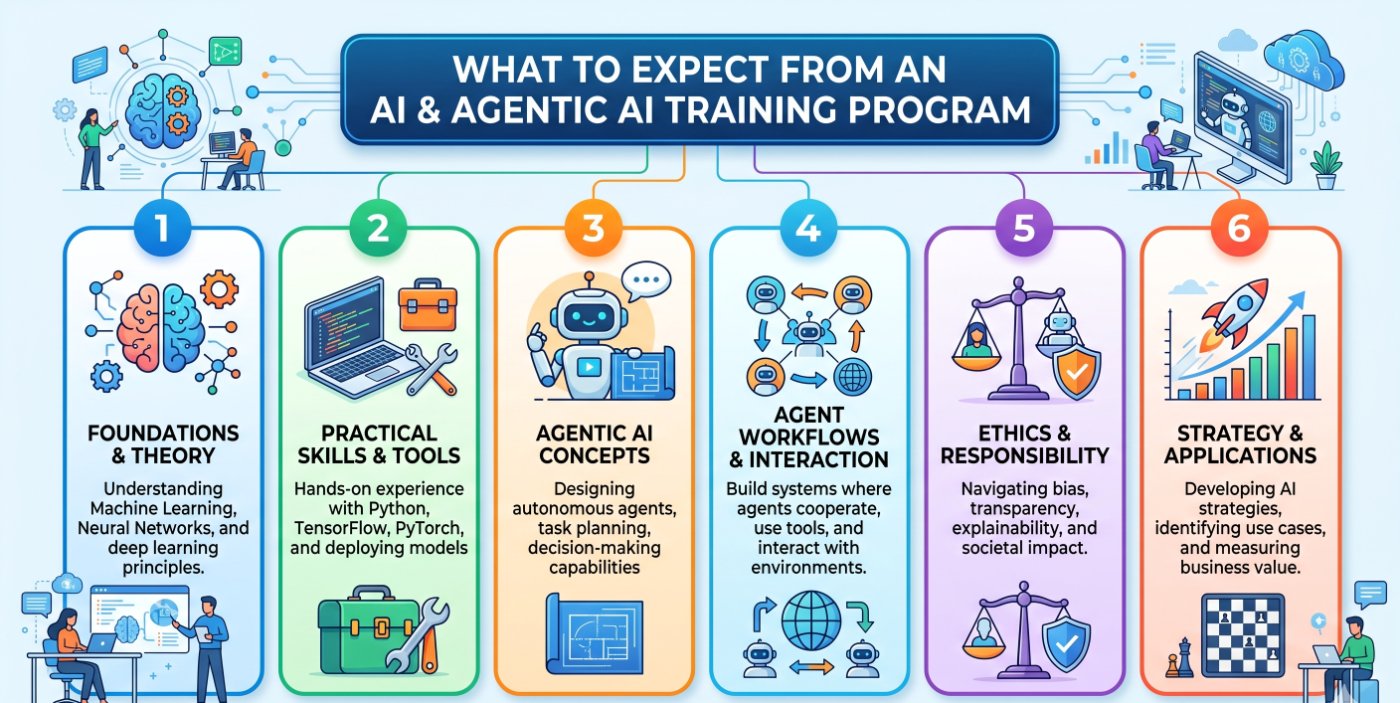
A well-designed AI and agentic AI training program covers both the conceptual and the practical. On the conceptual side: how AI systems work at a meaningful level, the difference between types of AI, the fundamentals of agentic systems and the agent loop, and the ethical considerations that come with autonomous AI. On the practical side: how to use leading AI tools effectively, how to write powerful prompts, how to build simple automation workflows, and how to evaluate AI outputs critically.
What You Will Be Able to Do
By the end of a quality program, you should be able to: use AI tools to dramatically accelerate your daily work; write prompts that get consistently excellent results; understand when AI is a good fit for a task and when it is not; build simple agentic workflows that automate repetitive tasks; participate confidently in organizational discussions about AI adoption; and critically evaluate AI outputs rather than accepting them uncritically.
What It Will Require from You
Learning AI is not passive. The programs that produce results are those where learners show up, experiment, make mistakes, and apply what they learn to real problems. Expect to spend time practicing between sessions. Expect to feel confused sometimes — that confusion is where learning happens. Expect the field to keep moving, which means learning AI is an ongoing practice, not a one-time credential.
Come as a curious practitioner, not a passive student. The participants who get the most out of AI training programs are those who bring real problems from their work and use the training to solve them. The training is a catalyst your curiosity and application are the fuel.