Why AI Literacy Is the Most Important Skill of the Next Decade
Every few decades, a new technology arrives that fundamentally restructures who holds power, who creates value, and who gets left behind. The printing press. The industrial revolution. The internet. Each time, the people who understood and adopted the new technology early gained enormous advantages. The people who dismissed it or waited too long found themselves struggling to catch up. We are at one of those moments right now with artificial intelligence.
What Is AI Literacy?
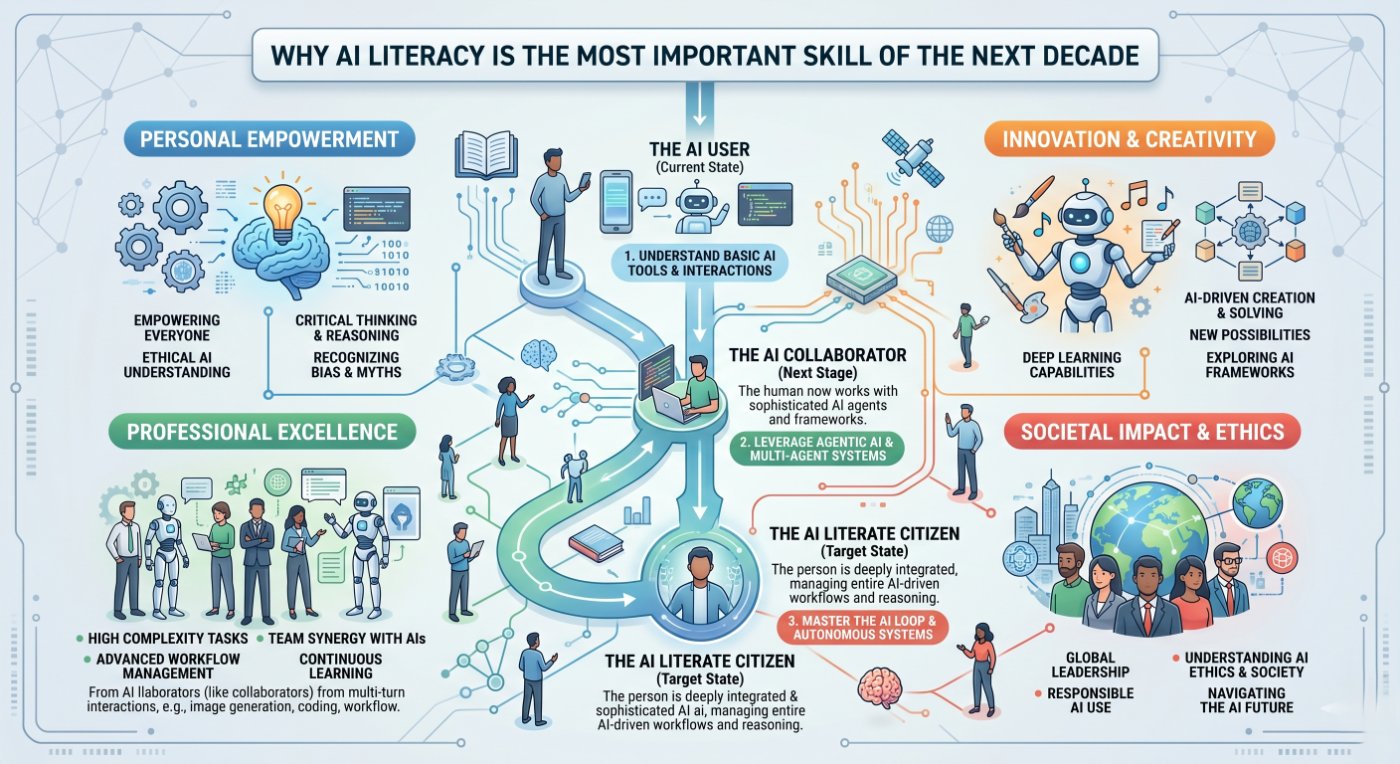
AI literacy does not mean learning to code neural networks or studying mathematics. It means understanding what AI can and cannot do, knowing how to work with AI tools effectively, being able to critically evaluate AI outputs, and having enough conceptual understanding to participate in conversations about how AI should be governed and deployed. Think of it like financial literacy you do not need to be a banker, but you need to understand money well enough to make smart decisions.
The Literacy Gap Is Already Widening
In organizations that have adopted AI tools, early evidence shows dramatic productivity differences between AI-literate employees and their peers. Studies from McKinsey, Stanford, and MIT suggest that workers using AI effectively are completing certain tasks 40–80% faster with no quality loss. In some knowledge work domains writing, coding, research, data analysis the gap is even larger. The AI-literate workers are not just faster; they are taking on more complex work, developing more ideas, and becoming more valuable.
It Is Not Just About Productivity
AI literacy matters beyond individual productivity. Decisions about AI which systems to deploy, what data to use, how to handle AI errors, what jobs to automate are being made right now in boardrooms, government offices, hospital systems, and schools. If the people in those rooms do not understand AI well enough to ask the right questions, those decisions will be poor ones. AI-literate citizens, leaders, and professionals make better decisions for everyone.
Unlike many technological shifts, AI literacy is genuinely learnable by anyone. The barrier is not mathematical genius or programming skill it is curiosity, critical thinking, and the willingness to engage with new tools. This training program exists precisely to lower that barrier.
What AI-Literate Professionals Can Do
They use AI tools to research, draft, analyze, and create dramatically amplifying their output. They critically evaluate AI-generated content rather than accepting it uncritically. They can communicate with technical teams about AI capabilities and limitations. They can lead or participate in AI adoption initiatives at their organizations. They can help set ethical guidelines for AI use in their field. And they can adapt as AI capabilities evolve because they understand the fundamentals, not just the current tools.