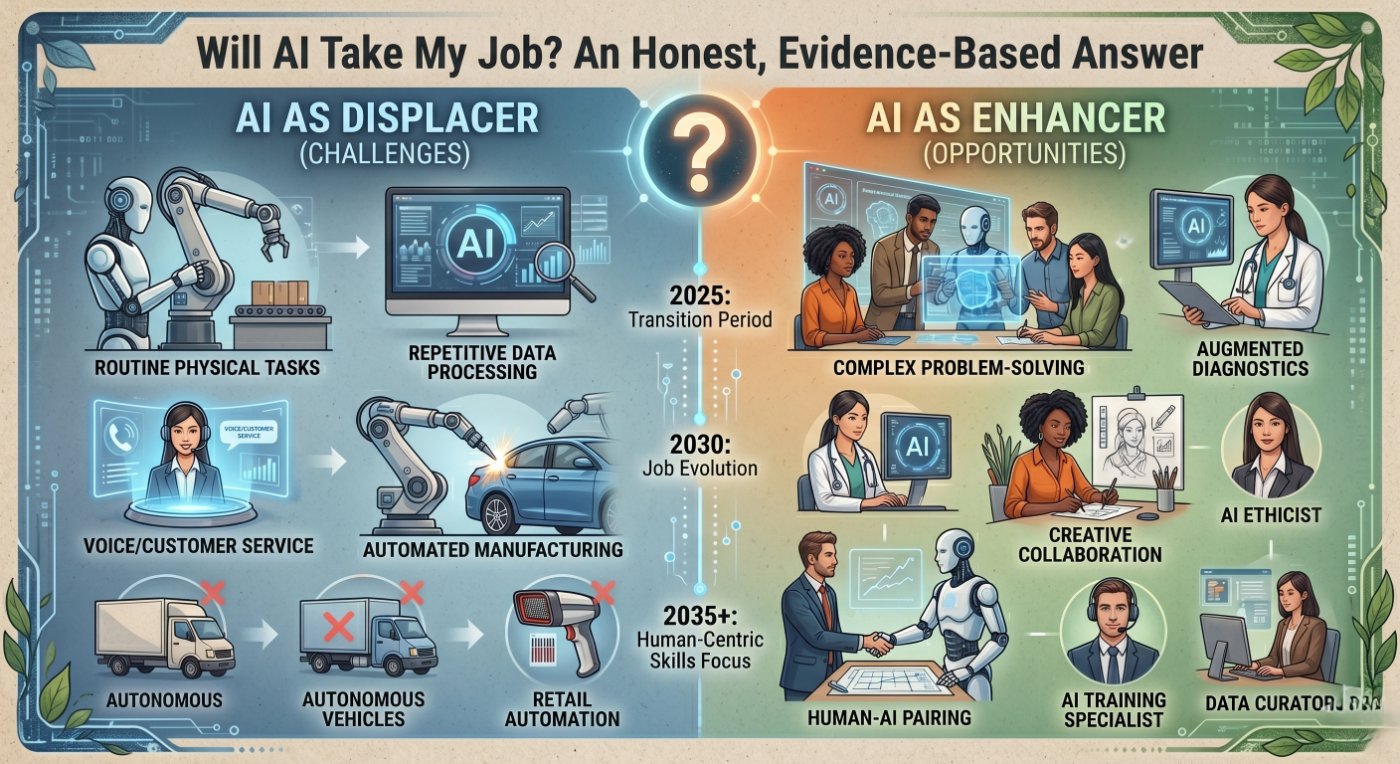
Will AI Take My Job? An Honest, Evidence Based Answer
This is the question that drives more anxiety than any other in the AI conversation. Workers across every industry from truck drivers to lawyers, from radiologists to copy writers are asking some version of it. And the honest answer is more nuanced than either the "AI will take everything" dormers or the "jobs are perfectly safe" optimists would have you believe.
What the Research Actually Shows
The most rigorous economic research on AI and employment suggests a consistent pattern: AI automates tasks, not jobs. Most jobs consist of many different tasks some highly routine and easily automated, others requiring judgment, creativity, social intelligence, physical dexterity, or contextual understanding that AI handles poorly. AI tends to take over the automatable tasks within a job, changing the nature of work rather than eliminating it wholesale.
A 2023 Goldman Sachs report estimated that AI could automate tasks equivalent to 300 million full-time jobs globally but also emphasized that historical technological shifts have always created more jobs than they destroyed, often in sectors that did not exist before the technology arrived. The internet eliminated millions of jobs and created tens of millions more.
Which Jobs Face the Highest Risk?
Jobs most at risk from AI are those characterized by: high routine, well-defined task structures; heavy reliance on information processing, document analysis, or data entry; limited requirement for physical manipulation of complex environments; and limited requirement for genuine human connection or emotional intelligence. This includes many clerical, administrative, data entry, and certain professional roles in law, accounting, and radiology that are heavily task-repetitive.
Which Jobs Are Most Resilient?
Jobs most resilient to AI automation share certain properties: they require complex physical manipulation in unpredictable environments (plumbers, electricians, surgeons); they are fundamentally relational (therapists, teachers, social workers, nurses); they require creative leadership and judgment in novel situations; or they involve setting the direction and priorities for AI systems themselves. The highest-value work in the age of AI is increasingly the work that tells AI what to do and evaluates whether it has done it well.
The Most Dangerous Position
The workers at greatest risk are not those in heavily AI-exposed roles. They are those in AI-exposed roles who refuse to adapt. A lawyer who learns to use AI tools for research, drafting, and document review will be dramatically more productive and valuable. A lawyer who refuses to engage with these tools will find themselves competing against AI-augmented colleagues and eventually automated systems. The technology is the same; the response to it is what determines the outcome.
"AI will not take your job. A person using AI will take your job unless that person is you."
What Should You Do?
Invest in AI literacy now, while the learning curve is still shallow. Identify which tasks in your current role are most automatable and develop expertise in the tasks that are not. Build skills in working with AI prompt engineering, AI evaluation, workflow design because these skills are complementary to AI, not replaceable by it. And stay curious: the specific tools will change, but the underlying capability to adapt and learn is the most durable advantage any worker can develop.